
In 2025, I completed a six-week course with Michael Collins from Cyber Cognition. The course focused on Systems Thinking, specifically DSRP Theory.
DSRP stands for Distinctions, Systems, Relationships, and Perspectives.
The theory was developed by Derek Cabrera. He argues that these four patterns sit underneath all human thinking. They shape how we organize information and make sense of the world. According to Cabrera, people can think more clearly by learning to use these four elements deliberately (1).
Over three blog posts, I will share the benefits of DSRP that I have personally experienced. I also explain where I consider DSRP to be universal, and where its limits are.
The Benefits of DSRP
A large study of 34,390 users (2) found that most cognitive activity is dominated by Distinctions (~58%). Far fewer people use Systems thinking (~21%), Relationships (~18%), or Perspectives (~2%):
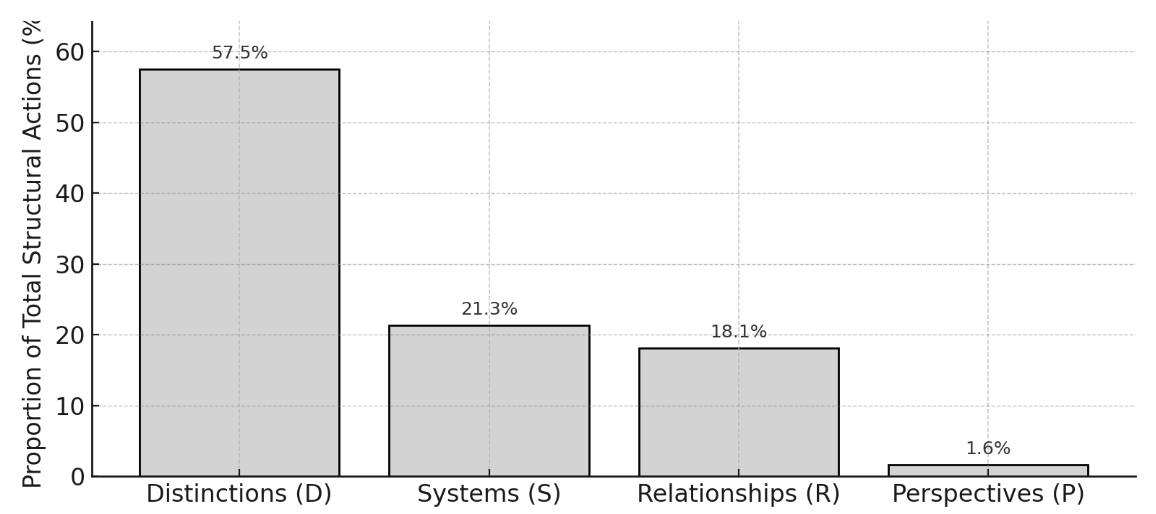
In short, we’re affected not only by cognitive biases, but also by what the Cabreras call the ‘metacognitive blindness’ created by structural neglect.
The consequences of this study are dramatic.
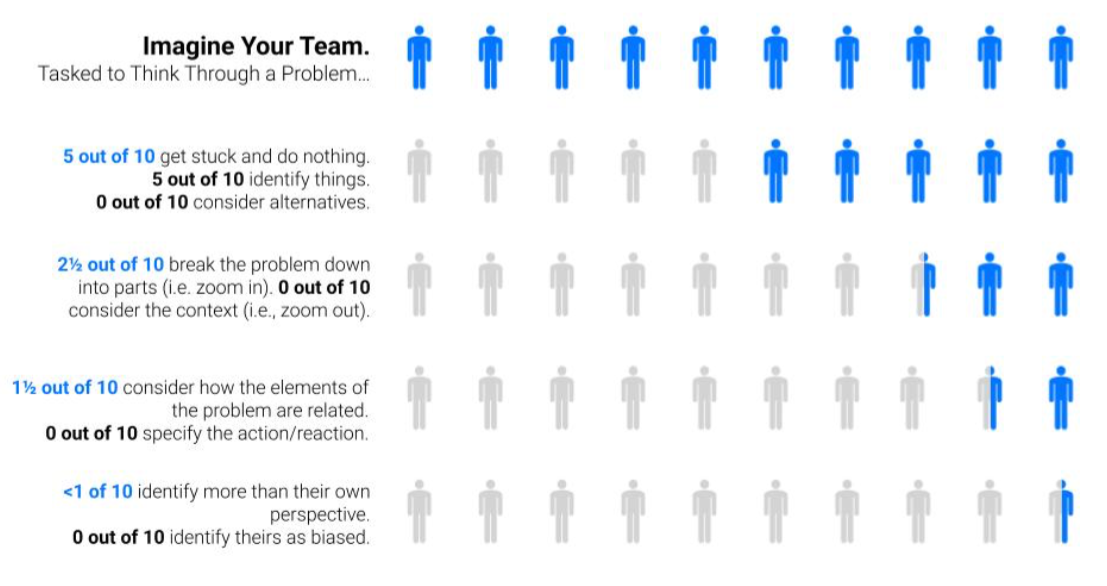
Imagine your team produces 100 ‘thinking moves’ while framing a problem:
Based on the dataset in the study, about 58 of those moves will be naming/identifying distinctions, about 21 will be breaking things into parts/wholes, about 18 will be connecting things, and only about 2 will be explicit perspective-taking.
That imbalance is a recipe for blind spots.
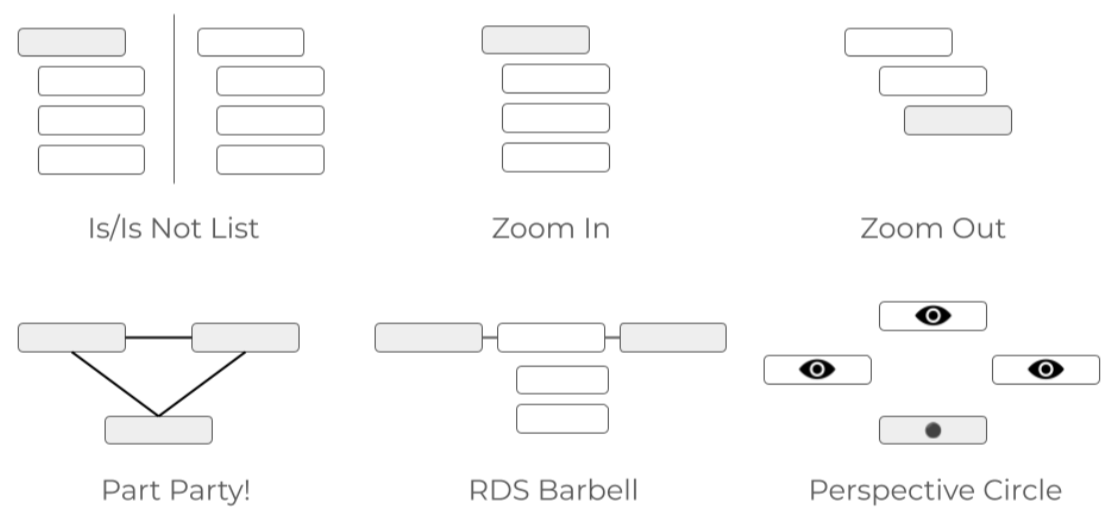
The study’s authors propose six high-leverage ‘mental moves’ aimed at rebalancing those neglected patterns:
- Is / Is Not (Distinctions)
- Zoom In (Parts)
- Zoom Out (Wholes)
- Part Party! (Relate parts)
- RDS Barbell (Zoom in to Action–Reaction relationships)
- Perspective Circle (Point–View)
I quote the benefits of learning the 6 moves:
“Subsequent studies on the developmental effects of the Six Mental Moves have shown consistent, large-scale improvements in both higher-order cognition and emotional intelligence—ranging from 247% to 551% gains in systems thinking skill, problem-solving, and metacognitive awareness. These findings demonstrate that even brief, structural practice interventions can reorganize cognition itself, producing rapid, transferable gains in clarity, adaptive reasoning, and integrative systems thinking.” (2)
These percentages come from over 3 million coded “structural actions” made by 34k+ users during cognitive mapping tasks, so they describe what people tended to do in that measured context (not a timeless census of all human thought).
The study’s authors explicitly frame the work as “limited and promising” and call for replication, controlled trials, and cross-context validation. But it does establish that “systems thinking is a measurable, empirical, improveable, practicable set of skills.”
Conclusion
The value of DSRP is clear. It offers a simple way to notice what our thinking is missing and a practical set of moves to correct for those gaps. For me, this alone made it a useful and immediately applicable framework.
Anyone who reads my blog will notice that I now use DSRP consistently. Learning its four patterns and eight elements has materially improved how I think, analyze, and communicate - and I strongly recommend it.
I also highly recommend Michael Collins as a teacher, along with his course. For those who want to go deeper, the research published in the Journal of Systems Thinking is well worth reading (although I openly challenge a very small subset of papers in part 3 of this blog series).
In the next post, I turn to a deeper question: why does DSRP work so broadly across domains? To answer that, we need to look at the internal logic of the theory and the claims it makes about universality.
References
-
Systems Thinking, August 2008, Cabrera; Colosi; Lobdell
-
The Pareto Structure of Thought : Empirical Discovery of the Six Foundational Mental Moves, October 2025, Derek Cabrera; Laura Cabrera
Thank you for reading. If any errors or misunderstandings appear in this article, they are entirely my own and should not be attributed to Derek and Laura Cabrera or their work.