

How much might individuals need to spend if a cyber professionalization scheme made degrees and certifications the fastest route to Chartered status?
To test that question, I built a financial model and ran 15,000 Monte Carlo simulations. The average projected cost was $105,295.22 AUD per individual.
The model also suggests this is not just a cost story for individuals. It points to a substantial commercial opportunity for peak bodies, universities, and training vendors, with the lower-bound total addressable market estimated at AUD 95 million to AUD 1.6 billion in Australia alone.
Using the 2021 Australian Census count of individuals working in cybersecurity as a reference population, the corresponding lower-bound estimate is around AUD 288 million.
In this article, I set out the methodology behind the model, the assumptions used, and what the results may mean. I have also made the Excel spreadsheet available so readers can examine the model and test the assumptions for themselves.
Research Question
The key question this research investigates:
What level of financial expenditure might individuals incur under a hypothetical cyber professionalization scheme that rewards degrees and certifications as the fastest pathway to Chartered status?
Introduction
At its core, a professionalization scheme is a formal standard that sets out the criteria an individual must satisfy in order to be recognized as a professional in a given field.
These criteria matter because they do more than define status. They shape behavior. They influence which qualifications people pursue, which providers benefit, and how much individuals are likely to spend in order to advance their careers.
An example can be found in an open-source professionalization proposal submitted to the Department of Home Affairs in 2022. (1) That proposal included a list of pre-approved industry certifications designed to “fast track” individuals toward the more prestigious chartered designation:
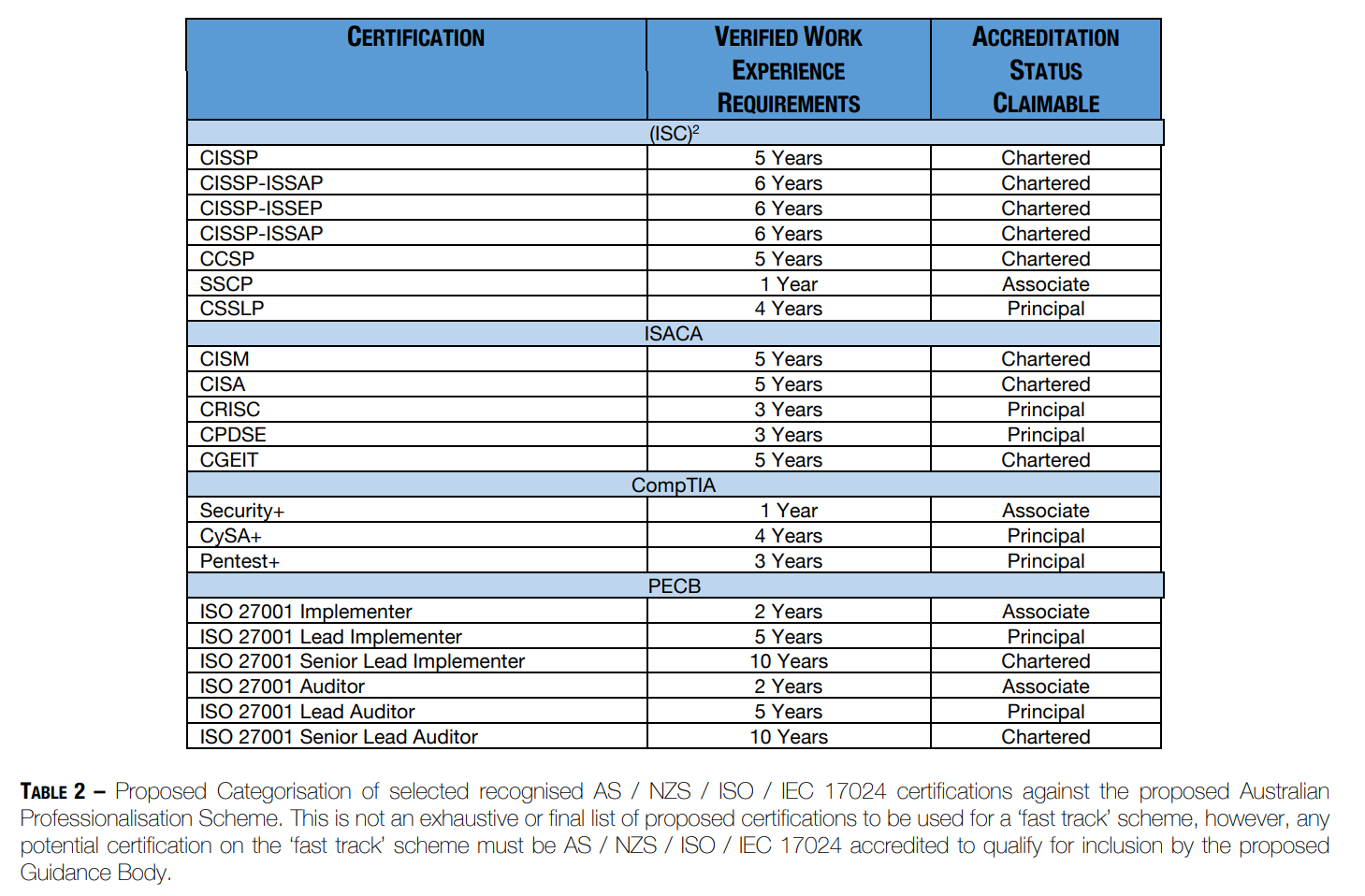
This is a critical point. Even when a scheme offers multiple pathways, the pathway presented as the fastest or most attractive route to chartered status can create a significant market advantage for the universities, peak bodies, and certification vendors included within it.
The structure of the scheme also affects the total financial burden placed on individuals.
In the same open-source proposal, another pathway uses a points-based system:
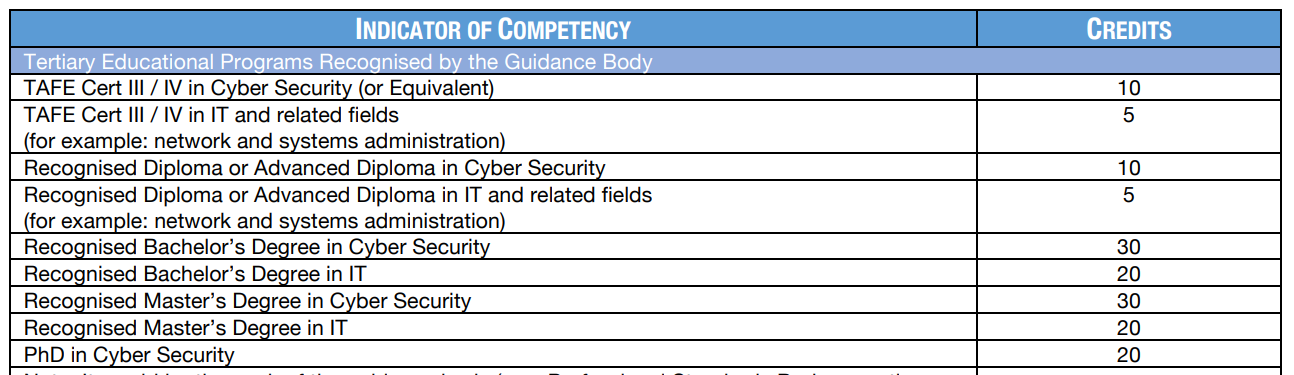
For individuals, each point requirement translates into further spending on degrees, certifications, or related forms of accreditation.
That means a professionalization scheme can be examined as an economic mechanism. It is therefore possible to approximate the expenditure an individual might incur to satisfy the standard and progress toward the top title.
Methodology
This study was conducted in four stages:
- Design of a hypothetical professionalization scheme
- Collection of financial data to parameterize the model
- Construction of a cost model to estimate the expenditure required for an individual to attain the highest title
- Estimation of the total addressable market that such a professionalization scheme could create for universities, peak bodies, and certification vendors
Hypothetical Professionalization Scheme Design
To avoid singling out any particular organization or individual, this study models a hypothetical professionalization scheme.
For the purposes of the analysis, the scheme was defined in simple terms: individuals are rewarded for accumulating a combination of higher education qualifications and industry certifications.
Under this hypothetical standard, the minimum requirement to achieve the Principal title was assumed to be one bachelor’s degree and one industry certification, while the minimum requirement to achieve the Chartered title was assumed to be one bachelor’s degree and two industry certifications.
The model also assumed that the scheme would include areas of specialization. On that basis, individuals may in some cases be required to obtain a greater number of certifications, with the upper bound in this study set at five industry certifications in total to satisfy both title and specialty requirements.
For the absence of doubt, this study does not estimate the cost of any proposed or real-world scheme. Rather, it demonstrates how a professionalization framework that privileges degrees and certifications could generate substantial costs for individuals. The resulting estimates should therefore be interpreted as conditional on those assumptions.
Data Collection
Data were first collected to parameterize the cost model. The dataset comprised three categories of inputs:
-
the fees charged by each of the 18 associations approved by the Professional Standards Councils in Australia, including both initial accreditation fees and recurring annual maintenance fees;
-
the published costs of widely recognized cybersecurity certifications; and
-
the published costs of higher education qualifications relevant to the model, including bachelor’s, master’s, and doctoral degrees.
A financial model was then constructed to estimate the potential expenditure incurred by individuals pursuing accreditation under different assumptions. To account for uncertainty and heterogeneity in possible pathways, the model incorporated cost ranges and probability-based assumptions derived from the collected data.
Monte Carlo simulation was subsequently used to estimate the distribution of potential individual expenditure. A total of 15,000 simulated individuals were generated, with pathway costs sampled according to the model parameters. Descriptive statistics were then calculated, including the mean, minimum, and maximum estimated expenditure. In addition, a histogram was produced to examine the distributional characteristics of the simulated results.
Model Variables
The model simulated values for five variables:
- the annual cost of membership with a professional peak body;
- the cost of a representative industry certification;
- the annual renewal cost of industry certifications;
- the cost of higher education qualifications, including bachelor’s, master’s, and doctoral degrees; and
- the number of industry certifications an individual may obtain and maintain over time.
Each uncertain input was modeled using a triangular distribution defined by minimum, most likely, and maximum values. For simplicity, the model assumed independence between variables.
Example
An example might help the reader better understand the model:
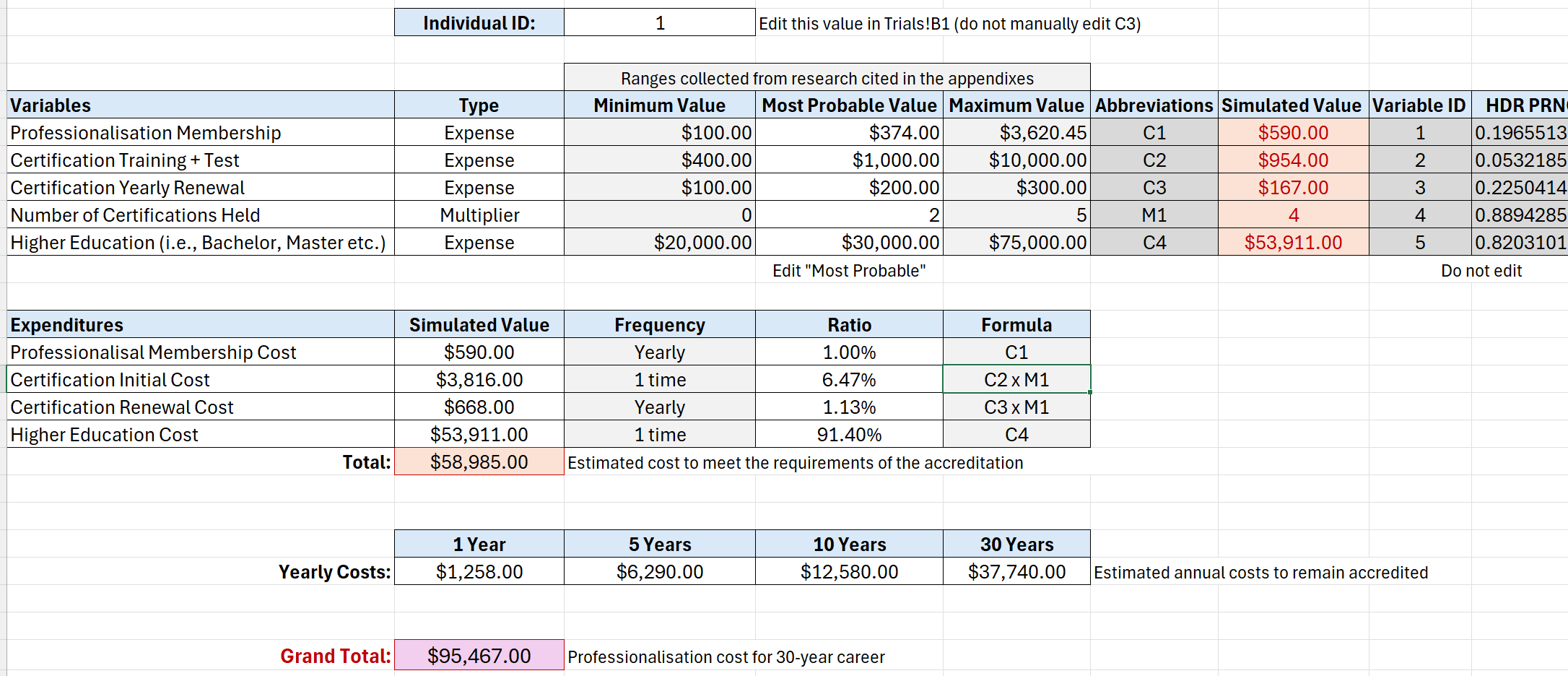
The figure above presents a single simulated individual who successfully attained the Chartered title. This individual is labelled “1” because they represent the first simulated individual in the set of 15,000 Monte Carlo simulations.
The table at the top displays the model input variables. For each variable, a minimum, most likely, and maximum value was specified based on the data collected during the data collection phase of the study.
The column labelled “simulated value” (in red) shows the specific value drawn by the model for this individual simulation.
The second table provides a category-level breakdown of the initial expenditures associated with attaining Chartered status.
In this simulated case, the estimated cost for the individual to achieve the Chartered title and maintain professional accreditation for the first year was AU$58,985.
The table below then sets out the annual recurring costs associated with renewing accreditation and maintaining certifications. In this case, the simulated individual was assumed to hold four certifications requiring ongoing renewal.
Over a 30-year period, these recurring annual costs amount to AU$37,740.
The final figure shown at the bottom is the grand total of AU$95,467, representing the estimated expenditure required for this individual both to meet the initial professionalization standard and to maintain it over 30 years.
Limitations
The following expenses are not accounted for by the model:
- Cost of retaking tests
- Interest payments on student loans or other forms of borrowing
- Price increases due to inflation
- Travel expenses to attend training or pass an exam
- Any other cost not explicitly included in the Excel spreadsheet
Furthermore, the model does not account for “years of experience” as a parameter in the professionalization standard.
Finally, the model estimates the total expenditure associated with a hypothetical pathway to Chartered status. It does not distinguish between costs newly induced by the scheme and costs that some individuals may have incurred irrespective of professionalization.
Findings
Finding 1: The model estimated that professionalization could cost an individual between approximately AUD 31,000 and AUD 227,000
Assuming a professionalization scheme that incentivises participants to obtain higher education qualifications and industry certifications, the Monte Carlo simulation of 15,000 hypothetical individuals produced the following estimated expenditure outcomes:
- Minimum estimated expenditure: AUD 31,758.00
- Average estimated expenditure: AUD 105,295.22
- Maximum estimated expenditure: AUD 227,248.00
Finding 2: The model estimated that 59% of individuals would incur total expenditure between AUD 80,000 and AUD 120,000
The histogram below presents the probability distribution generated by the Monte Carlo simulation:
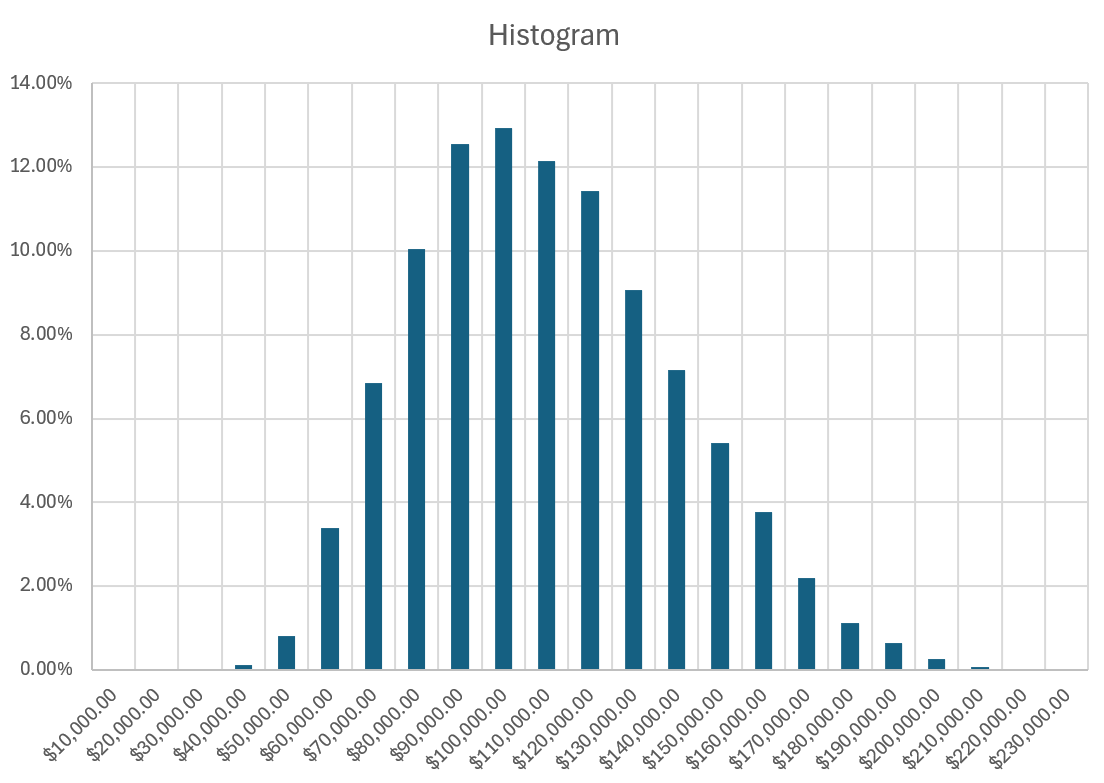
Across the 15,000 simulated outcomes, 59% fell between AUD 80,000 and AUD 120,000.
Finding 3: The model estimated a lower-bound total addressable market ranging from approximately AUD 95 million to AUD 1.6 billion
Using the minimum modeled expenditure of AUD 31,758 as a conservative lower-bound input, the implied revenue opportunity would range from approximately AUD 95 million to AUD 1.6 billion depending on participation levels.
In summary:
-
If 3,000 individuals each spent AUD 31,758.00, the resulting market size would be approximately AUD 95 million.
-
If 51,309 individuals each spent AUD 31,758.00, the resulting market size would be approximately AUD 1.6 billion.
The precise number of individuals who may ultimately be affected by such a professionalization scheme is unknown. However, data from the 2021 Australian Census indicated that 9,061 individuals identified their work as being in cybersecurity.
Using the 2021 Census data as a reference population, the corresponding lower-bound revenue estimate is AUD 287.8 million.
Discussion
Prior research has found that professionalization and occupational licensing can produce higher prices and reduced consumer choice, in part because licensing requirements increase wages and restrict competition from unlicensed entrants. (2, 3)
The financial simulation presented in this study is consistent with those findings. If a professionalization scheme promotes expensive degrees and certifications as the fastest route to the highest status, and individuals must spend more than AUD 100,000 to get there and maintain that status throughout their careers, then they may seek to recover part of that investment through higher wages or higher service fees, which could place upward pressure on the cost of cybersecurity services.
The simulation scenario is also consistent with concerns previously raised in policy commentary that professionalization may raise barriers to entry. (4) Where progression depends on the ability to finance university degrees, certifications, memberships, and ongoing renewals, individuals who cannot afford these costs may be excluded from advancement, regardless of their real-world capability.
Another concern raised in prior commentary is the risk of capture by financially interested stakeholders. (4, 5) This concern is not difficult to understand. Where a scheme confers a structural advantage on selected forms of education, particular vendors, or approved institutions, it may distort competition by steering demand toward preferred providers. Over time, this can entrench incumbents, weaken competitive pressure, and reduce incentives for providers to improve quality or lower prices.
Finally, individuals who are expected to make substantial financial investments in order to advance under such a scheme are entitled to scrutinize the value of the pathways being promoted. If a professional is effectively being asked to spend tens of thousands of dollars, and in many cases more than AUD 80,000, on cybersecurity education and accreditation, it is reasonable to expect a system that allows them to pursue the highest-quality options available in the market, rather than a narrow set of providers that may have benefited from institutional selection or policy influence. (5, 6)
This concern may be especially salient in a field such as cybersecurity, where practical capability has often developed outside traditional higher-education pathways.
Recommendations
Although this study was conducted using a hypothetical professionalization scheme, it demonstrates that Monte Carlo simulation can be used to estimate the expenditure individuals may be required to incur in order to comply with the rules and parameters of an accreditation pathway.
This approach may be useful to governments, industry bodies, professional associations, and other organizations involved in the design of professionalization schemes for the cybersecurity sector.
The following recommendations emerge from this study.
Recommendation 1: Model all proposed pathways before implementation
This may appear self-evident, but failing to understand in advance how much it will cost an individual to comply with a pathway could undermine adoption and legitimacy. Pathways should therefore be modelled before implementation to ensure they are financially achievable and do not create unnecessary barriers to entry.
Recommendation 2: Identify who financially benefits from each pathway
It is important to examine who ultimately benefits from the expenditure required by a scheme.
The primary beneficiaries should be professionals, aspiring professionals, and the consumers who rely on their services. Spending should be associated with measurable improvements in competence, capability, and service quality, and where relevant, with measurable reductions in risk for those engaging accredited practitioners.
If a pathway appears to confer disproportionate financial benefit on training vendors and institutions without delivering measurable value to professionals and consumers, it creates a material risk that the professionalization scheme will be perceived as lacking legitimacy.
Recommendation 3: Design pathways that reward quality, relevance, and affordability
A professionalization scheme does not merely recognize standards; it helps determine which providers gain structural advantage.
For that reason, schemes should be designed to encourage training providers and higher education institutions to deliver the highest-quality courses at the most economical price point.
The strongest pathways will reward innovation, current and evidence-based training materials, real-world skill development, broad and adaptable capability, problem-solving, critical thinking, creativity, and demonstrable performance. In other words, schemes should reward proof over rhetoric, tasks over passive knowledge, and skills over credentials alone.
Recommendation 4: A competency-Based accreditation pathway could justify higher annual fees
Pathways that rely on degrees and certifications as the primary means of validating competence can impose substantial costs on individuals. According to the model, membership fees in such pathways account for only around 1 to 5 per cent of the upfront financial burden of initial accreditation. Over a 30-year period, however, recurring membership fees become a much more significant share of the total cost.
This finding suggests that the overall structure of the pathway matters far more than membership fees alone. It is the pathway design that ultimately determines both what can reasonably be charged and the return on investment for professionals who pay to participate.
A cybersecurity professionalization scheme that charges $150 to $400 per year merely to validate paperwork may offer limited value to professionals. By contrast, a scheme charging closer to $1,000 per year could be more justifiable if it replaced expensive degree- and certification-based requirements with a lower-cost, competence-based assessment model.
Conclusion
This study demonstrates that it is feasible to construct a financial model capable of estimating the potential cost of professionalization to individuals, conditional on the design parameters and incentive structures embedded within the scheme.
Although the model presented here is not without limitations, it currently provides a transparent and reproducible basis for estimating the financial burden that professionalization may impose. Those who disagree with the assumptions, structure, or findings of the study are in a position to refine the model, update the underlying data, or test alternative scenarios.
Click here to download the Excel Spreadsheet and test for yourself.
If you identify an error in this study or in the underlying model, please contact me with an explanation, and I will correct the study and/or the model accordingly.
References
-
2023-2030 Australian Cyber Security Strategy. Response to discussion paper, Kordamentha, April 2023
-
Cartels by Another Name: Should Licensed Occupations Face Antitrust Scrutiny?, Rebecca Haw Allensworth, January 2014
-
Understanding First, Solutions Second: A Systems Thinking Analysis of the Proposed Australian Cybersecurity Professionalization Scheme, Michael Collins, June 2025
-
Reconsider the Australian Government’s grant for professionalising the cybersecurity industry, Benjamin Mosse, January 2025
-
Designing the Gate: Inside Australia’s Cyber Professionalization Effort, Benjamin Mosse, November 2025
-
Only 6 out of 220 recommended professionalisation to Home Affairs, Benjamin Mosse, April 2025