

A credible cybersecurity professionalization body requires more than formal authority. It also requires stable, recurring revenue to govern independently, audit effectively, investigate complaints, and enforce decisions. Without adequate funding, professionalization risks becoming symbolic rather than operational.
Prior modelling suggested that credible operation would most often require annual expenditure between AUD 3 million and AUD 5 million (1), but that analysis assumed a uniform membership fee. This study extends that work by examining whether a salary-linked fee model could more plausibly finance a credible body, and under what conditions of membership size, workforce participation, and contribution rates.
The results suggest that a salary-linked model may be financially viable, but only where contribution rates are roughly 1.0% to 1.25% of salary and membership reaches the low thousands. Across 15,000 Monte Carlo simulations, most viable outcomes generated average annual fees between AUD 700 and AUD 1,100 and revenue above the study’s AUD 3 million lower-bound threshold. This range is also more consistent with the average fees charged by existing Professional Standards Council associations in Australia.
Problem Statement
Prior financial modelling of a hypothetical cybersecurity professionalization body suggested that the annual cost of credible operation would most often fall between AUD 3 million and AUD 5 million. In that earlier model, credible operation was defined as requiring, at minimum, independent governance, audit capacity, complaints investigation capability, and the ability to escalate and enforce decisions. (1)
A key limitation of that prior analysis was the assumption of a uniform membership fee applied equally to all members. This assumption is analytically convenient but unlikely to reflect how professional bodies operate in practice. Prospective members of a cybersecurity professionalization body would likely span a wide socioeconomic range, including students, unemployed or underemployed individuals, early-career practitioners, and high-income senior professionals. A flat-fee structure may therefore misrepresent both the affordability of membership and the revenue-generating capacity of the scheme.
In many established professional bodies, membership fees are not uniform, but differentiated according to factors such as professional status, career stage, or income. One common approach is to link membership fees, directly or indirectly, to annual earnings. Such models are intended to improve equity, widen access, and align financial contribution with members’ capacity to pay. However, it remains unclear whether a salary-linked fee structure would generate sufficient revenue to fund a cybersecurity professionalization body operating at a level that could reasonably be described as credible.
This study develops a Monte Carlo simulation model to estimate the combinations of workforce coverage, membership uptake, and salary-linked fee rates required to finance a credible cybersecurity professionalization body. By replacing the flat-fee assumption with an income-sensitive contribution structure, the analysis seeks to test whether such a model is financially viable, and under what conditions.
Research Question
Under a salary-linked membership fee model, what combinations of membership size, workforce participation, and contribution rates would be sufficient to finance a credible cybersecurity professionalization body?
Methodology
The following methodology was employed:
- Specify the key input variables required to represent a salary-linked membership funding model.
- Construct a stochastic financial model linking member income bands to annual membership contributions.
- Run Monte Carlo simulations to estimate the distribution of possible annual revenue outcomes.
- Calibrate model parameters so that 60% of trials exceed AUD 3,000,000 in annual revenue, treated in this study as the minimum lower-bound funding threshold for credible operation.
- Analyze the resulting output distribution to identify plausible funding conditions for credible operation.
- Interpret the findings in light of the minimum funding requirements of a credible cybersecurity professionalization body.
The model was run for 15,000 trials to produce a stable distribution of outcomes and reduce the likelihood that the reported patterns were driven by simulation noise. The 60% calibration target was chosen as a modest viability threshold: high enough to require the model to exceed the AUD 3,000,000 lower-bound funding threshold in most trials, but not so high as to imply certainty or guaranteed institutional success.
Model Design
Model Variables
Three variables were identified as the principal determinants of revenue under the salary-linked membership model:
- Total membership: The number of individuals enrolled and contributing fees.
- Fee-to-income ratio: The proportion of annual income collected from each member as a membership fee.
- Income-band distribution: The proportion of members falling within each income band, which shapes the overall revenue profile of the model.
Justification of Modelling Choices
Monte Carlo simulation was used because the model inputs are uncertain rather than known with precision. It allows the study to test how variation in membership size, fee-to-income ratios, and income-band distributions affects annual revenue.
Triangular distributions were used because they provide a simple way to represent minimum, most likely, and maximum values. Income bands were used instead of exact salaries to keep the model tractable and to reflect how fee categories are often structured in practice.
The AUD 3,000,000 threshold was adopted as a conservative lower-bound estimate of credible operation based on prior modelling. The 60% calibration target was used to test whether the model could exceed that threshold in most trials, without implying certainty.
Parameter Ranges
The Total Membership and Fee-to-income Ratio parameters were modelled using triangular distributions:

The base values for the income bands were then specified in AUD 25,000 increments, spanning AUD 50,000 to AUD 250,000:
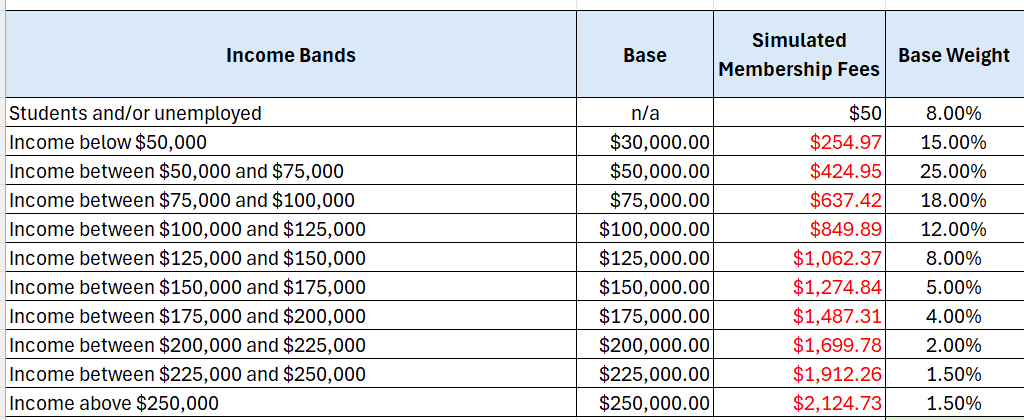
Income bands were then assigned baseline weights representing a hypothetical membership composition. These weights were randomized in each Monte Carlo trial to generate distinct membership distributions around the baseline structure. Although broad variation was permitted, the model constrained the overall shape of the distribution such that lower income bands consistently contained more members than higher income bands.
Example
As an illustrative example, one simulation trial produced a hypothetical professionalization body with 3,986 members. In this trial, each employed member was charged an annual membership fee equal to 1.33% of the base value of their assigned income band.
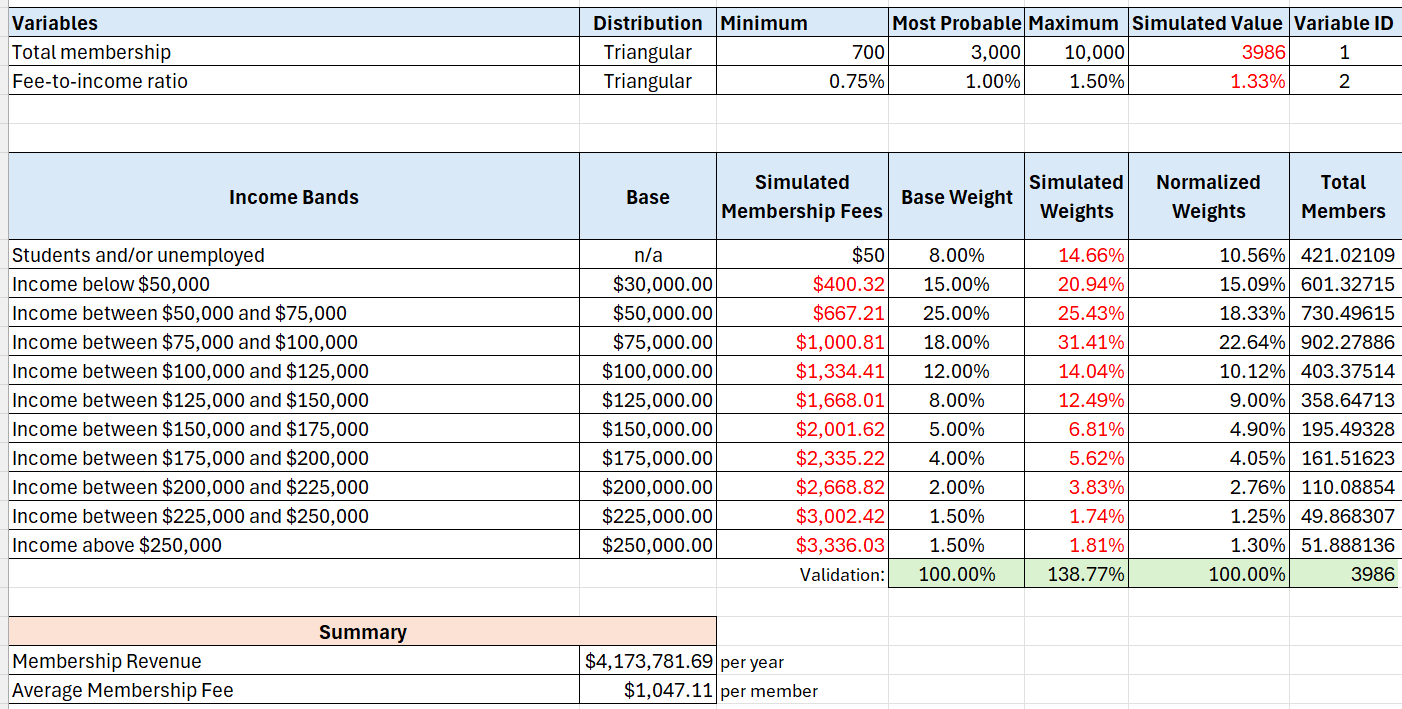
For example, a member in the AUD 100,000 income band would pay an annual fee of AUD 1,334.41.
This trial generated AUD 4,173,781.69 in annual recurring revenue, with an average membership fee of AUD 1,047.11 per member.
Assumptions
The model makes the following assumptions:
- A credible professionalization body requires annual funding broadly consistent with prior modelling.
- Membership fees can be linked to income without causing legal, administrative, or behavioral distortions that invalidate the model.
- The eligible cybersecurity workforce is large enough to support the simulated membership base.
- Members within the same income band can be reasonably represented by a common base income value.
- The simulated income-band weights are a plausible approximation of a real membership distribution.
- Lower income bands contain more members than higher income bands.
- Annual membership revenue is the primary funding source considered in the model.
- Students and unemployed individuals pay a flat annual fee of AUD 50.
Limitations
The following limitations apply to this model:
- The model does not use observed salary data from the full cybersecurity workforce or from an actual professionalization body.
- The income-band distribution is hypothetical rather than empirically validated.
- The model focuses on revenue generation and does not fully incorporate behavioral responses such as non-joiners, dropouts, fee resistance, or strategic under-reporting of income.
- The simulation does not test alternative fee structures such as flat fees, capped fees, tiered fees, or hybrid models in the same analysis.
- Revenue sufficiency is assessed against a lower-bound credibility threshold, which may understate the funding required for a more ambitious or more heavily regulated body.
- The results are scenario-based and should not be interpreted as forecasts.
- The model does not incorporate the administrative burden or compliance costs associated with verifying member income for the purpose of salary-linked fee assignment.
Findings
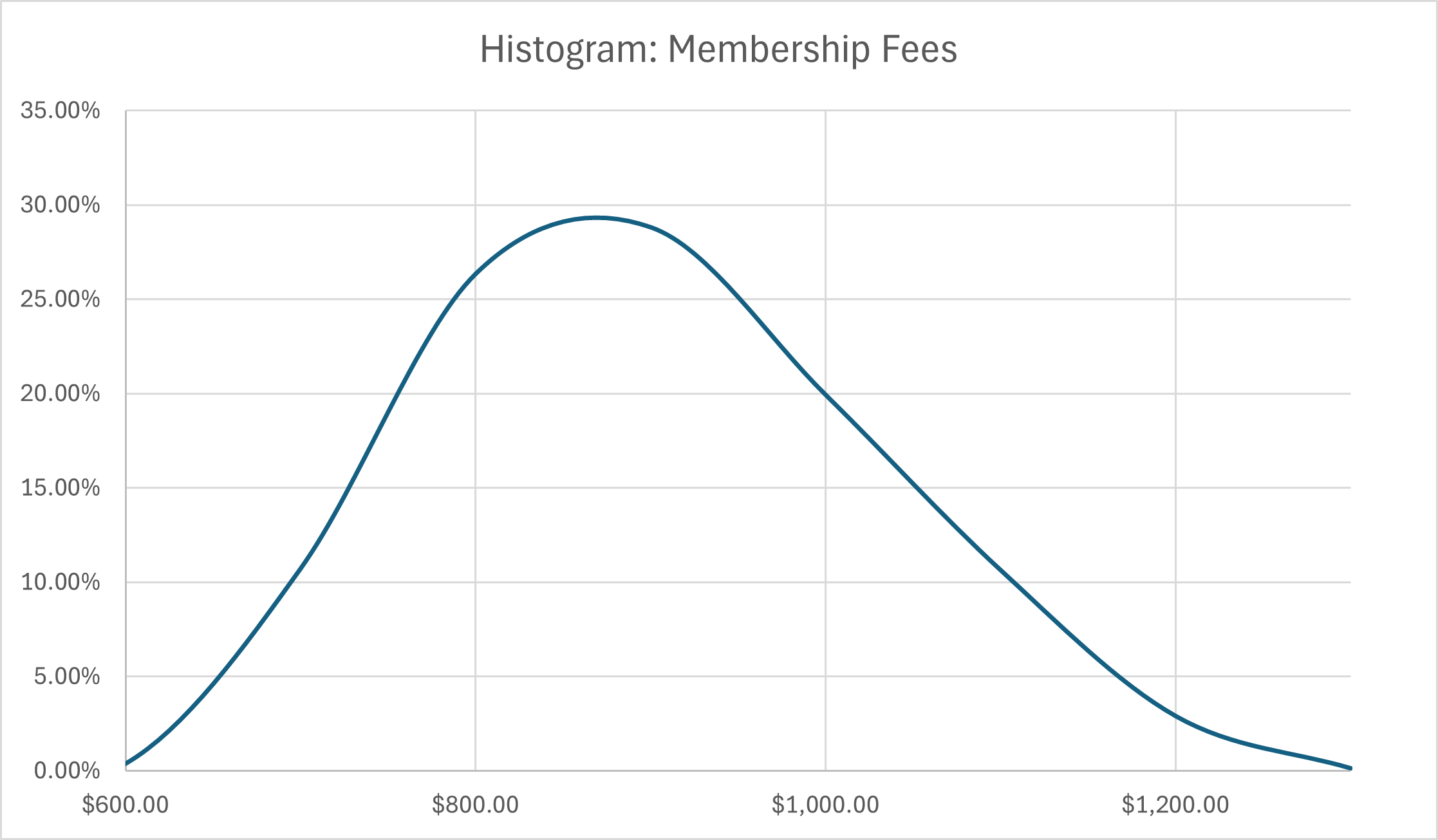
Finding 1: Average membership fees were concentrated between AUD 700 and AUD 1,100
In 96% of simulations, the average annual membership fee fell between AUD 700 and AUD 1,100.
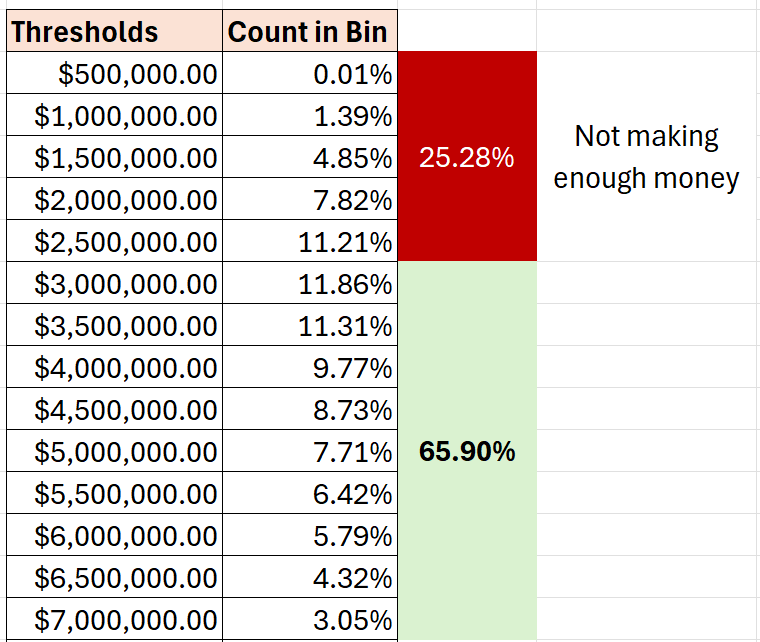
Finding 2: Annual revenue most frequently fell between AUD 3 million and AUD 7 million
In 65% of simulations, annual revenue exceeded AUD 3,000,000, the minimum lower-bound funding threshold for credible operation adopted in this study.
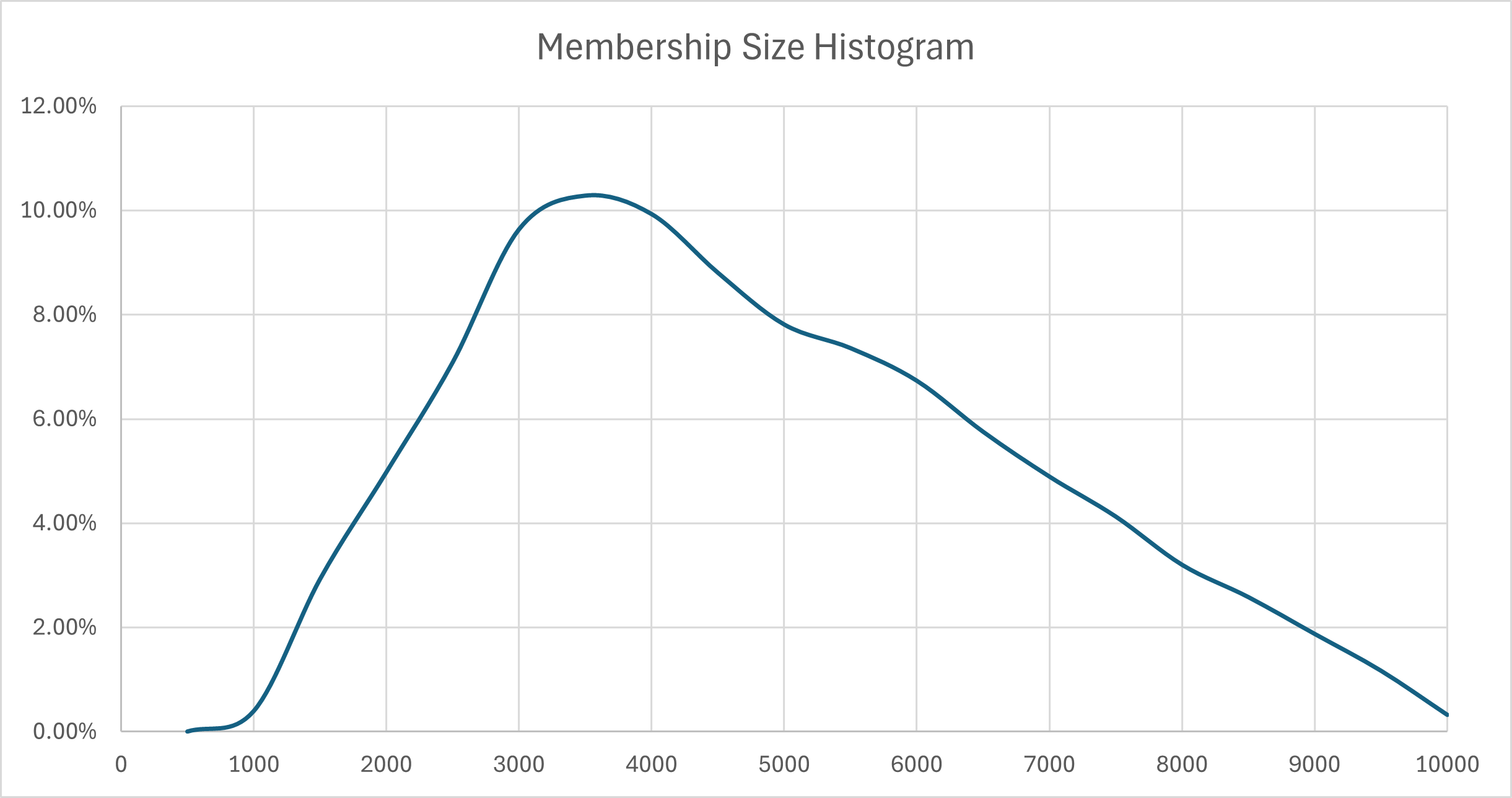
Finding 3: Membership size most frequently fell between 2,000 and 6,000 members
Membership size fell between 2,000 and 6,000 members in 72% of simulations.
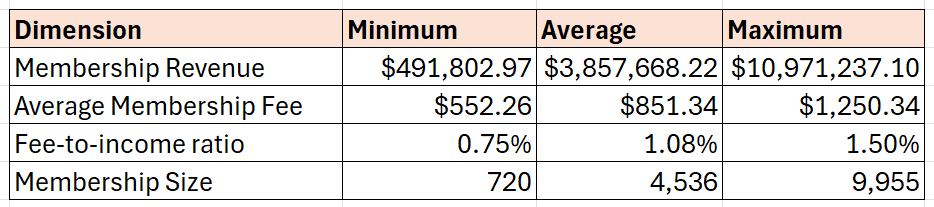
Finding 4: The average simulation generated AUD 3.86 million in annual revenue from 4,536 members
Across 15,000 Monte Carlo simulations, the average trial generated AUD 3.86 million in annual revenue from 4,536 members, with an average fee-to-income ratio of 1.08%.
Finding 5: 25% of simulations fell below the minimum revenue required for credible operation
Twenty-five percent of simulations produced less than AUD 3,000,000 in annual revenue, falling below the minimum lower-bound funding threshold for credible operation used in this study. These outcomes were generally driven by inadequate membership size, low fee-to-income ratios, or both.
Discussion
The simulation results suggest a substantive relationship between membership size, income distribution, and the fee-to-income ratio. Taken together, these dynamics indicate that earlier estimates of the average membership fee required to fund a credible cybersecurity professionalization body may have been understated. (1)
In 96% of simulations, the average annual membership fee fell between AUD 700 and AUD 1,100. This range appears more consistent with the average fees charged by existing Professional Standards Council associations in Australia.
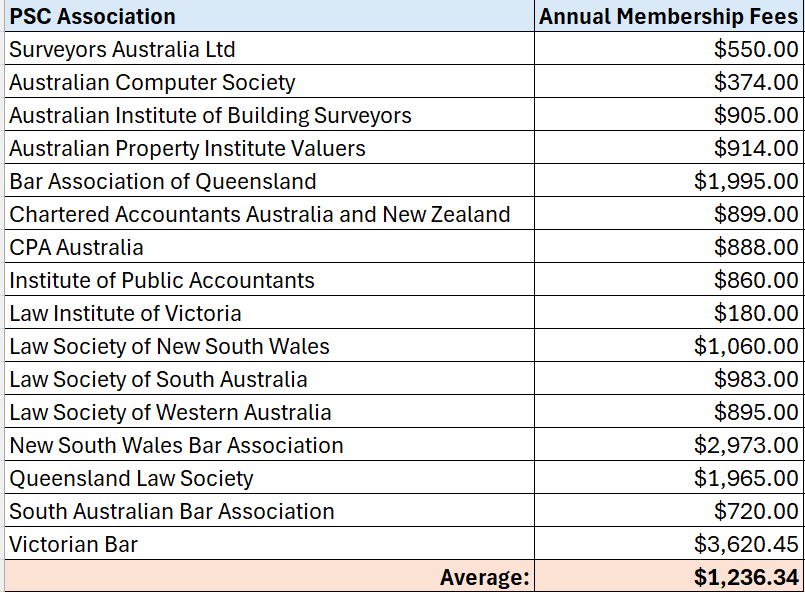
The comparison to Professional Standards Council associations is not intended to suggest that cybersecurity professionalization is identical to other regulated professions. Rather, it provides a rough external benchmark for whether the fee levels generated by the simulation are broadly within the range already observed among Australian professional bodies operating under formal professional standards frameworks. On that basis, the simulated fee range appears more institutionally plausible than substantially lower proposals.
These results do not establish a single required fee level. They do, however, suggest that a credible cybersecurity professionalization body is unlikely to be financed through very low membership fees. Under the assumptions adopted in this study, annual contributions in the order of 1.0% to 1.25% of salary appear more plausible than substantially lower alternatives.
Conclusion
This study examined whether a salary-linked membership fee model could plausibly finance a credible cybersecurity professionalization body. Across 15,000 Monte Carlo simulations, the results suggest that financial viability is possible, but only under conditions that combine sufficient membership scale with contribution rates materially higher than very low annual fee proposals. In most simulations, average fees clustered between AUD 700 and AUD 1,100, and the average trial generated AUD 3.86 million in annual revenue from 4,536 members.
Taken together, these findings suggest that a credible and capable professionalization body is unlikely to be sustained through minimal fees alone. Under the assumptions adopted in this study, financially credible operation appears more consistent with membership contributions of roughly 1.0% to 1.25% of annual salary, alongside a membership base measured in the low thousands rather than the hundreds. Although the model is scenario-based rather than predictive, it helps clarify the economic conditions under which cybersecurity professionalization may be financially plausible.
The model can be replicated using the provided spreadsheet, which contains all variables and simulation logic.
References
- What Would a Credible Cybersecurity Professionalization Body Cost?, Benjamin Mosse, March 2026